In short
- A new opener, installed: $250–$600 or $400–$900 on two HomeStars guides, $550–$1,200 and up on one Ottawa firm's list.
- A ceiling unit for a 7-foot door is about 10 to 10.7 feet long overall, and for an 8-foot door about 11 to 11.7 feet.
- A wall-mount unit frees the ceiling, needs torsion springs, and costs about 25% to 30% more.
- A charged backup battery covers 24 hours of standby and up to 20 cycles at room temperature.
Typical prices in Ottawa
| Job | Typical range | Notes |
|---|---|---|
| New opener, unit and installation | $250–$600 | HomeStars opener article |
| Labour only, opener you supply | $100–$250 | HomeStars opener article |
| New opener, installed | $400–$900 | HomeStars installation guide; belt drives higher |
| New opener, installed | $550–$1,200+ | One Ottawa firm’s published list |
| Wi-Fi module | $60–$150 | HomeStars installation guide |
| Exterior keypad | $50–$100 | HomeStars replacement guide |
| Outlet or circuit at the ceiling | $150–$400 | Billed by an electrician |
Sources. HomeStars, A Guide to Garage Door Opener Installation, Canada-wide, seen 29.10.2026. HomeStars, Garage Door Installation Cost in Canada, seen 29.10.2026. HomeStars, Garage Door Replacement Cost in Canada, seen 29.10.2026. One Ottawa firm’s published list: Ottawa Homeowners’ FAQ: Garage Door Repair Costs Explained, dated 26.08.2025, seen 29.10.2026. Rail lengths: opener maker’s installed-length chart, seen 29.10.2026. Wall-mount units: Canadian door maker, How Does a Jackshaft Garage Door Opener Work?, seen 29.10.2026. Battery backup: Canadian door maker, Why do I need a backup battery, seen 29.10.2026. Rules: ESA, homeowners, seen 29.10.2026; Ontario, guide for home renovation businesses, seen 29.10.2026. Outages: Hydro Ottawa, May 21, 2022 major event, seen 29.10.2026.
Get the door right first
An opener lifts a door that the springs already hold in balance. HomeStars warns that a new motor on a door that binds, sags or will not stay open by itself wears out faster. If a spring looks broken or the door hangs crooked, our pages on broken springs and a door off its track cover that job.
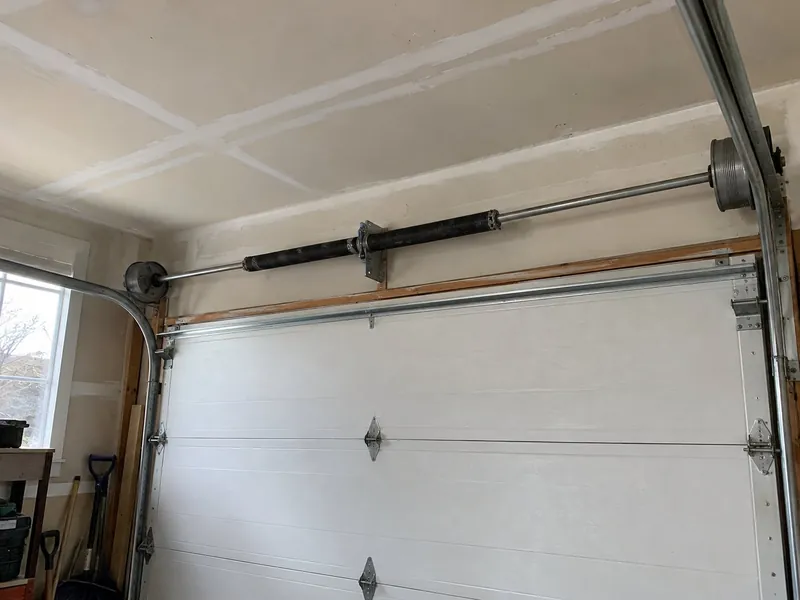
The springs also limit the choice of opener. A wall-mount unit turns the spring shaft directly, so it needs torsion springs above the door. A photo of the springs settles this before the visit.
Room behind the door
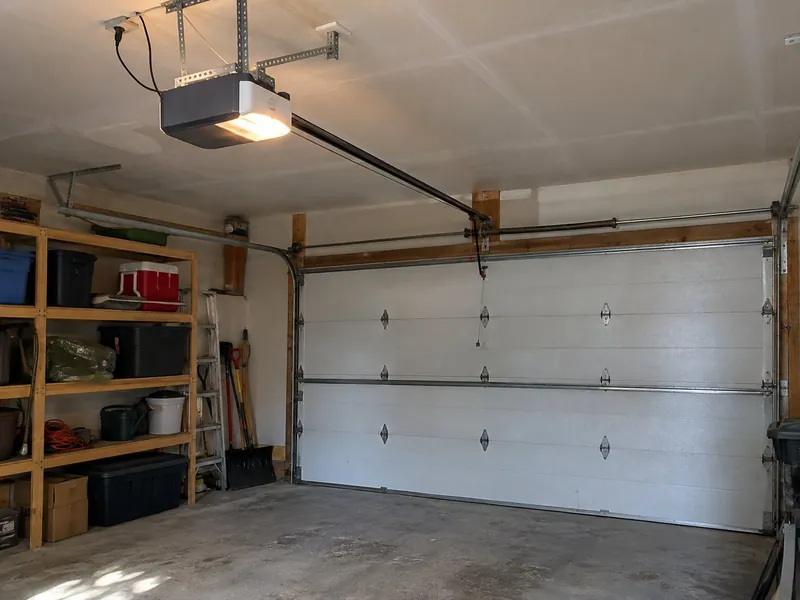
A ceiling opener hangs on a rail running from a bracket above the door toward the back wall. One maker publishes the installed length of its units:
- 7-foot door: about 121 to 128 inches overall
- 8-foot door: about 133 to 140 inches overall
That length is measured from the header wall toward the back, and the space has to be free of beams, poles and other obstructions. Look for ducts, a light, a storage rack or a freezer in line with the centre of the door, and give the door height so the company brings the right rail.
Ceiling height and the wall-mount option
HomeStars notes that a vaulted, sloped or low ceiling may need a low-headroom kit or a wall-mount unit, which adds cost and time. A Canadian door maker describes the wall-mount (jackshaft) case:
- High ceilings. An 8-foot door under a 12-foot ceiling, where the owner wants storage overhead.
- Sloped or cathedral ceilings. A side unit stays reachable for service.
- Limits. Torsion springs only; doors up to 14 feet tall or 180 square feet; unsuitable for low-headroom doors.
The same maker puts it at about 25% to 30% more than a ceiling unit, with the same installation time and the same reversing safety systems.
Drive type and lifting power
HomeStars sums up the drives: chain is the cheapest and loudest, belt is quieter for a little more, screw has fewer moving parts, and direct drive runs smoothly at a higher price. Noise counts most with a bedroom over the garage; our belt vs chain page goes deeper.
Higher-horsepower models cost more, and HomeStars says a heavy insulated double door can be too much for an older half-horsepower unit. Ask what door size and weight the quoted model is built for, and mention an insulated door you have or plan to buy.
Power at the ceiling
Most openers plug into an outlet within reach of the motor; some are wired in. With no outlet there, an electrician adds one first. If the old unit runs on an extension cord across the ceiling, say so.
ESA says the notification for electrical work should be filed before the work starts, and that a building permit is a separate thing.
Battery backup and Ottawa outages
On May 21, 2022, a storm cut power to 180,946 Hydro Ottawa customers; 90% were back by May 28 at 6 p.m. If the garage is your daily way in, price a battery backup with the opener.
A Canadian door maker rates a charged battery at 24 hours of standby and up to 20 full cycles, with four and a half hours to recharge. A battery from one brand will not fit another brand’s opener. Without one, every opener has a red release cord that frees the door for lifting by hand during an outage; the installer can show you how the trolley reconnects afterwards.
What the installation quote should list
- Brand, model, drive type and the door size or weight it suits
- Rail extension, low-headroom kit or wall-mount hardware
- Both safety sensors, the wall button and the number of remotes
- Keypad, Wi-Fi and battery backup, each on its own line
- Old unit removal, the electrician’s part, labour and HST
- Auto-reverse test and force and travel limits set on the day
Ontario requires a written agreement for work over $50, caps the bill at 10% over the estimate without a signed change, and gives 10 days to cancel a contract signed at home. Remotes from another brand’s opener usually need replacing; see remotes and keypads.
Who handles your request
Ottawa Garage Door Desk is a request service. We send what you write in the form to one independent local garage door company. That company calls you back, looks at the door, the ceiling and the power, prices the installation and does the work.
Questions to ask the company
- Which model are you quoting, and what door size and weight is it built for?
- Does my door need a rail extension, a low-headroom kit or a wall-mount unit?
- Will you check the springs and the door's balance first?
- Is removal of the old unit in the price, and how many remotes come with it?
- Will you test the auto-reverse and set the force and travel limits?
Have this ready for the call
- Door width and height, and whether it is insulated, steel or wood
- Ceiling height, and a photo from the door toward the back wall
- Beams, ducts, lights or racks in line with the centre of the door
- A photo of the springs, and whether a room sits over the garage
- How the old opener gets power: ceiling plug, extension cord, wired in
Questions people ask
Does a new opener need a building permit?
HomeStars says an opener on its own does not typically need one, since the structure stays the same. Enlarging the opening or adding wiring can change that, so ask the City about those parts.
The ceiling is low or sloped. What are the options?
HomeStars lists a low-headroom kit or a wall-mount unit, and both add cost and time. A wall-mount unit needs torsion springs and, per one Canadian maker, cannot go on a low-headroom door.
Can my old opener go on a new door?
HomeStars says installers often remount one under a decade old when it is sized for the new door’s weight. Any opener made before 1993 lacks the photo-eye sensors now required.
Does a backup battery work in the cold?
The 24-hour, 20-cycle figure is given at 15 to 25°C. Ask what the quoted model delivers in an unheated garage in January.
Who installs the outlet at the ceiling?
An electrician, at $150 to $400 on HomeStars’ guide. ESA says almost all electrical work in Ontario must be reported to it, and a hired installer must by law be a Licensed Electrical Contractor.